
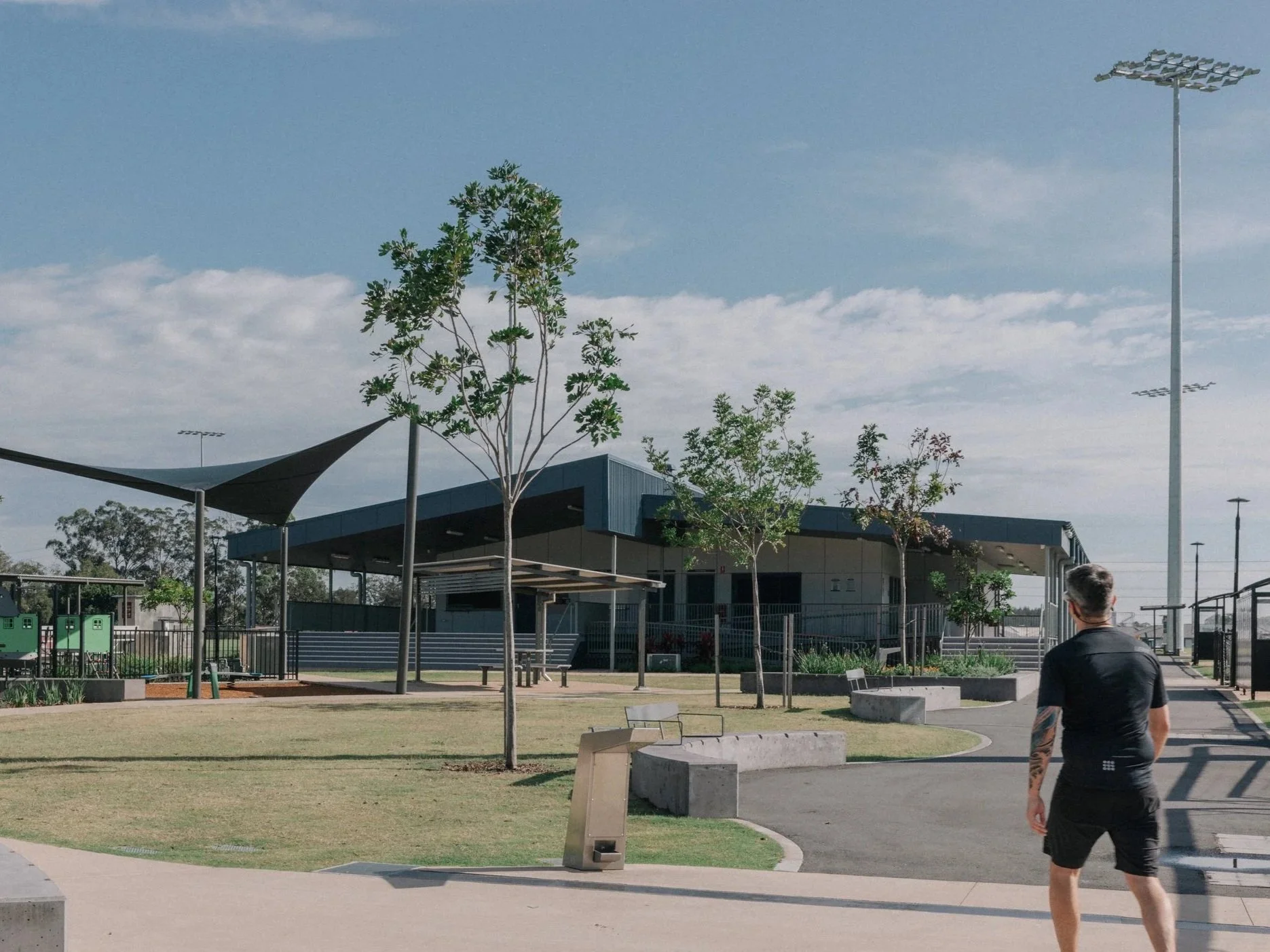
Nudgee Recreation Reserve
Landfill site restored to its former glory as a sporting and recreation precinct
Location Nudgee, QLD (Turrbul Country)
Client EPOCA Constructions for the Brisbane City Council
Value $800,000
Status Built
Project Type Sport & Recreation
The Nudgee Recreation Reserve project restored a former landfill site and reestablished the precinct as a vibrant sports and recreation complex for the growing communities of Brisbane's north. Open Architecture Studio was the lead consultant on the project, responsible for engaging all necessary subconsultants and delivering a D&C package for a 740m² shared clubhouse, including public amenities, change rooms, umpire's room, sports equipment storage, kitchen/canteen, administration area, and a spectator viewing verandah overlooking the fields.
The precinct services a broad range of community uses — touch football, cricket, soccer, BMX, fitness equipment and pathways, a dog off-leash area, playground, and picnic and BBQ facilities — complementing the growing network of sport and recreation infrastructure across Brisbane.
Delivering on a former landfill site required a carefully considered and technically rigorous design response. The building is raised above ground level to create a ventilated undercroft, allowing landfill gas to vent naturally and providing essential separation between the structure and the capped landfill below. Rather than a piled foundation — which would risk penetrating the clay capping layer — a stiffened raft slab was adopted, allowing the entire building to move as a single unit and accommodate the differential settlement inherent in landfill and controlled fill conditions. Steel construction was specified to minimise building weight and reduce the impact of any ground movement over time.
All services are suspended beneath the building within the undercroft space, with connections to ground occurring entirely outside the building footprint — eliminating the risk of penetrations through the slab. Adjustable column heads allow floor levels to be maintained as the surrounding soil settles, ensuring the long-term performance and integrity of the facility.
The site was originally a sporting ground in the 1940s, and this project returns it to community use — a reminder that with the right design thinking, even the most challenging sites can be transformed into places that serve and inspire.